
.jpg)
What Is a Listed Building? Grades, Consent, & Insurance

In the UK, a listed building is one formally recognised for its special architectural or historic interest and protected in law. Listing applies to the entire building inside and out, and often curtilage structures. Most alterations require listed building consent from the local planning authority before any work starts.
rivr specialises in high value home and contents cover for Grade II and II* listed buildings. We specialise in providing All Risks cover that addresses the unique requirements of period properties.
What are listed buildings?
A listed building is included on a statutory register because of its special architectural or historic importance. In England the official register is the National Heritage List for England, which is publicly accessible. All listed buildings are included in this database, ensuring transparency and accessibility for the public.
The UK uses three categories in England and Wales, with parallel systems in Scotland and Northern Ireland to recognise particularly important buildings and protect them through the planning system.
How listing works
Listing highlights buildings of architectural or historic interest, from exceptional architectural pieces to structures that contribute collectively to the character of a street, terrace, or historic townscape. In England, Historic England assesses and advises, and the Secretary of State makes the decision.
Wales uses Cadw, Scotland Historic Environment Scotland, and Northern Ireland the Historic Environment Division. Rarity, a particular period, historic associations, and architectural interest are common listing criteria. Public consultations and feedback from heritage groups are important components of the listing process in England.
There are about 379,000 listed buildings recorded in England (2024), within roughly 401,000 total designated entries on the National Heritage List for England. Historic England has created selection guides to assist with the listing process. This listing process identifies historic buildings that are nationally or locally significant and sets out why they matter.
Where the records live
You can search the heritage list for England online to find the list entry, map references and statements of significance. Wales, Scotland and Northern Ireland host similar searchable portals.
In England, start at Search the List.
In Northern Ireland, see the NI Buildings Database
Scotland and Wales publish consent and guidance pages that link to records and policy. You may also encounter registered parks and gardens, registered battlefields and protected wreck sites in the databases, which are related designations recorded alongside buildings.
Why are buildings listed?

Authorities look for design quality, craftsmanship, intactness, historic interest, and sometimes unusual examples or major examples of a building type. Age matters because the older a building is (and the fewer that survive) the more likely it is to be listed. The state of repair of a building isn't generally considered in the decision-making process for listing.
Most buildings before 1700 that survive in something like their original condition are likely to be listed, with many buildings built between 1700 and 1850 also listed. Some sites are instead protected as ancient monuments or scheduled monuments where archaeological value is of national importance.
Grades explained
Reviewed 10 November 2025
England and Wales
- Grade I: Buildings of exceptional interest.
- Grade II*: Particularly important buildings of more than special interest.
- Grade II: of special interest, warranting every effort to preserve.
In England, around 2.5% are Grade I, about 5–6% are Grade II*, and nearly 92% are Grade II. (Historic England). Grade I denotes exceptional interest, which is why it represents such a small share of all listed buildings.
Scotland
.jpg)
- Category A: national or international importance.
- Category B: regional or more than local importance.
- Category C: local importance, often representative or altered examples.
Applications are made much like planning permission and are free, with demolition tightly controlled. In Wales, the listing process is administered by Cadw, with authority granted to the Welsh Ministers. There are about 30,000 listed buildings in Wales, contributing to less than 1% of the total building stock.
For process guidance, see listed building consent in Scotland
Northern Ireland
- A to B2 categories reflect decreasing levels of significance, but all are protected. The public can explore listings through the NI Buildings Database; local authority councils determine consent. Start with finding a listed building in Northern Ireland
What the grade means for consent and insurance
Higher grades usually face more than special interest scrutiny, but any listed building that may be affected by works needs consent. Because repair often involves traditional methods, property owners should expect longer programmes and costs that influence insurance sums and claims handling.
Reinstatement can involve materials such as lime, stone and handmade slate, which take time to source and apply.
How do I check if a building is listed?
You can confirm listing status by searching the National Heritage List for England. The list entry describes significance, location and sometimes attached features. Equivalent databases exist in the other home nations, and many councils host conservation pages with links to local records.
Search steps and what the entry shows
Use the postcode or building name, check the map pin, and read the general principles and description. The entry may reference group value, fixtures, garden walls and ancillary structures that are included. Photographs and mapping where available can help you confirm you have the correct property and understand the extent of protection.
Curtilage and attached structures
Listing usually covers the whole building and, by law, any object fixed to it and structures within its curtilage that have formed part of the land since before 1 July 1948. Whether something is within the curtilage is determined by the local planning authority, and it can ultimately be a matter for the courts if disputed.
Do I need listed building consent?
If proposed works affect the building’s special architectural or historic significance, you may need listed building consent before starting. This is separate from planning permission. Carrying out works without consent is a criminal offence, and authorities can require reversal at the owner’s expense.
For more insight, see section 9 of the Planning (Listed Buildings and Conservation Areas) Act 1990
Works that usually require consent
- Altering or replacing original windows and doors or external joinery.
- Changing roofing materials, chimneys, or structural timbers.
- Internal alterations that affect plan form, fireplaces, panelling or staircases.
- Extensions, solar panels, services runs, new openings, or removing garden walls attached to the house.
These typically affect special interest and therefore need consent.
Routine maintenance you can usually do
Like for like repairs using the same materials and detailing are commonly acceptable and may be outside formal consent, but you should confirm scope with your local planning authority. Using unsuitable modern substitutes can harm significance and risk enforcement. Keeping gutters clear, replacing slipped slates and repointing with compatible lime mortars are typical examples.
The consent process
Applications usually include a clear description of proposed works and why they are necessary, with heritage impact reasoning. Most applications are determined by your local planning authority, often with advice from national bodies or conservation officers.
Fees: In England and Wales, there is no fee for a stand-alone listed building consent application (planning fees may apply if submitted with a parallel planning application). In Scotland, listed building consent is also free.
Timeline and who decides
You apply to the local planning authority. England and Wales councils decide, taking Historic England or Cadw advice where relevant; Scottish and Northern Irish authorities consult Historic Environment Scotland or HED for certain cases.
Local planning authorities are responsible for the management of listed buildings in both England and Wales. Some projects, especially demolition or substantial alteration, receive higher scrutiny and may be notified to national bodies.
What to submit with your application
Most applications include scaled drawings, photographs, a heritage statement explaining the historic environment and the building’s special architectural significance, plus method statements describing traditional materials. Early pre-application discussions can often shorten decisions and reduce conditions because proposals can be refined before submission.
Common projects and practical guidance
Windows and doors
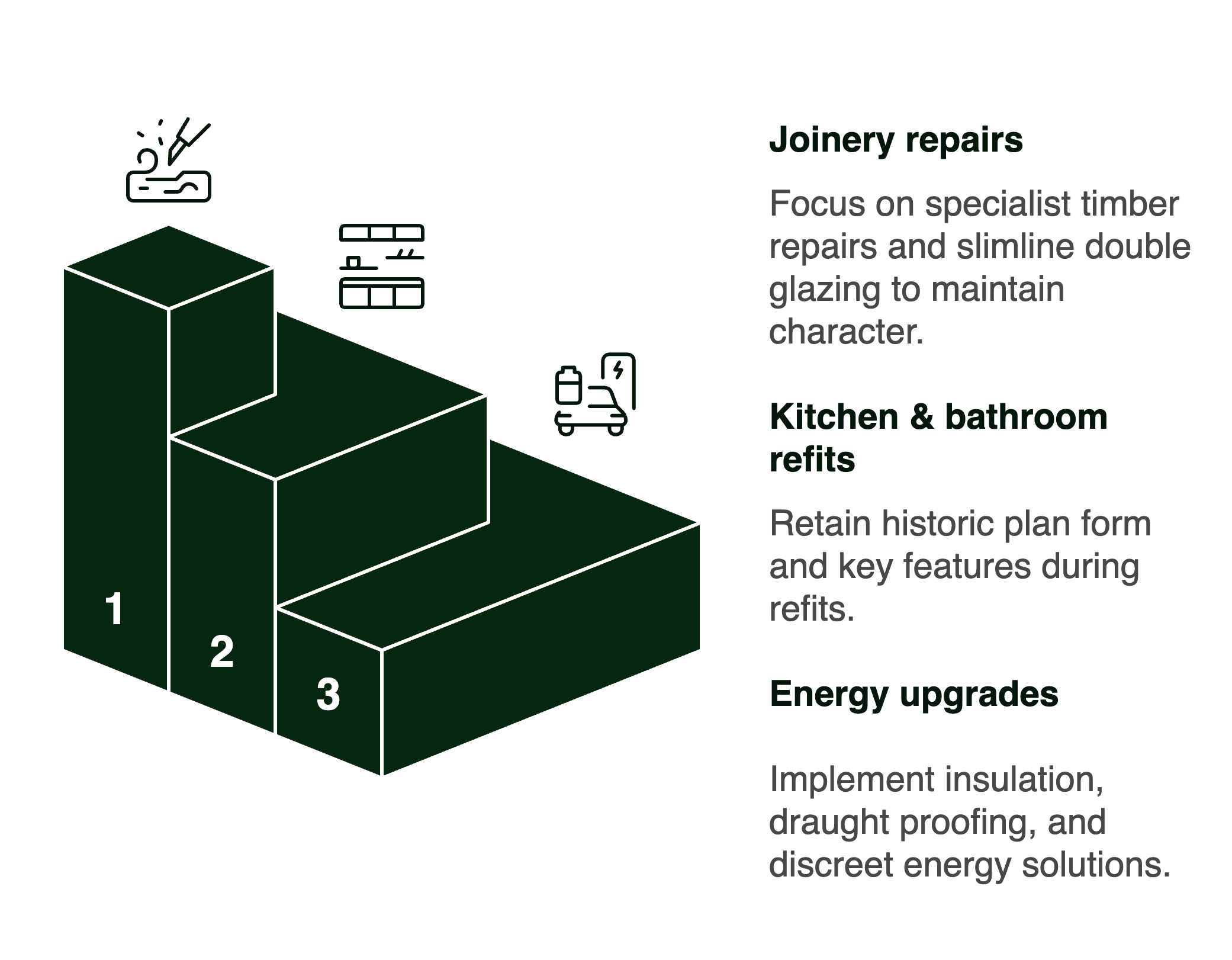
Because joinery often contributes strongly to character, complete replacement in uPVC (unplasticized polyvinyl chloride) will rarely be acceptable on historic fabric. Specialist timber repairs, slimline double glazing set within appropriate glazing bars, or high quality secondary glazing are common solutions that respect special interest.
A short trial repair can demonstrate performance while keeping original material.
Kitchens, bathrooms and services
Refits should retain the historic plan form and key features. Services can often route through secondary spaces with minimal chasing and reversible fixings. Where fabric loss is unavoidable, consider recording and labelling removed elements so that future owners understand what has changed and why.
Energy and sustainability upgrades
Many upgrades are possible where they avoid harm. Roof insulation above ceilings, secondary glazing, draught proofing, lime-based wall repairs, and discreet locations for heat pumps or solar panels are typical. Curtilage structures and fixings can still require consent, so confirm scope early.
Insurance for listed buildings
Rebuild cost vs market value
Insure for the rebuild cost, not the selling price. High quality policies often define buildings to include outbuildings, garden walls, paths, drives, fixed services and more. Index linking may apply, and a professional reinstatement assessment is often prudent for complex heritage assets where specialist methods and longer programmes drive costs.
Claims, timescales and traditional methods
Repairs after an insured event may require specialist trades and traditional materials such as lime, oak, lead and stone. Some policies include features like alternative accommodation for an extended period and cover to trace and access leaks.
Always notify your insurer of planned building works above the thresholds set in your wording so that cover and conditions remain aligned.
Protect your Grade II and II* listed home with rivr cover designed for conservation and modern living.
Ownership essentials
Buying, selling and mortgages
Solicitors generally will check listing status, consents and any enforcement history. Lenders may require evidence that past works received approvals. In England you can apply for a Certificate of Immunity from listing in certain scenarios, which prevents listing for a set period, though it does not remove conservation area controls.
Anyone can apply for a Certificate of Immunity from Listing at any time in both England and Wales.
Maintenance responsibilities and enforcement
Owners are legally responsible for proper upkeep. Unauthorised works are a criminal offence and can lead to prosecution and a requirement to reverse the works. A temporary 'Building Preservation Notice' can be issued if a building is at risk of demolition or alteration. Enforcement also covers curtilage structures, and councils can serve notices where neglect puts significance at risk.
Myths and facts
rivr: High-value home insurance, built around modern life

rivr is a high-value, digital-first home insurance provider built around the needs of modern lifestyles.
Listed properties need accurate rebuild valuations that account for traditional construction methods and longer restoration timescales. Rivr specialises in insuring high-value period properties, with expertise in assessing reinstatement costs for heritage features.
Our All Risks policy provides:
- Rebuild cost cover for buildings (Section 1)
- Professional fees and costs (up to 25% of buildings sum insured)
- Up to 36 months of alternative accommodation
- 24/7 property emergency helpline
- Large Loss Excess Waiver (no excess on qualifing claims over £15,000)
Speak to our team today to find the right level of contents cover for your home and lifestyle.
Resources
- Historic England overview of listed buildings and the Heritage List for England.
- Search the List in England.
- Managing Change to Listed Buildings in Wales, Cadw
- Listed building consent in Scotland, Historic Environment Scotland
- Finding a listed building in Northern Ireland, NI Direct (https://www.nidirect.gov.uk/articles/finding-listed-building).
- Principles of selection for listed buildings, UK Government.
- Offences under the 1990 Act, legislation.gov.uk.

Read more
.avif)
.webp)

Frequently asked questions
A building on an official register because of its architectural or historic interest, protected so that changes are carefully managed through the planning system.
Grade I buildings are of exceptional national interest (about 2–3% of listings) and usually face the strictest control over changes.
While Grade II buildings are of special interest (the vast majority, ~90%+) with consent still required for works that affect their significance but typically with less stringent requirements than Grade I.
People routinely purchase listed buildings, but the process may involve additional due diligence. Buyers typically review that past works had listed building consent, commission a survey from a conservation specialist, and arrange insurance based on the rebuild cost.
Consider the potential maintenance costs, longer timelines for alterations, and a lenders who may ask for extra documentation.
Yes. We can insure listed properties (subject to underwriting) for Grade II* and Grade II or equivilant. Tell us the listing grade and any planned works so we can set the right terms. For limits and conditions, see the rivr Home Insurance IPID and Policy Wording.
England and Wales use Grade I, Grade II* and Grade II; Scotland has Category A, B, C; Northern Ireland has A to B2. All carry legal protection and may require consent for works that affect their special interest.
Usually listing applies to the entire building, inside and out, plus objects fixed to it and many structures within the curtilage.
Yes. Unauthorised works to a listed building breach the 1990 Act and may lead to prosecution and enforced reinstatement.
They are separate. A building in a conservation area is not automatically listed, but both regimes can apply and interact with planning permission.
